The Power of Achieving on One's Own
Creates Greater Possibilities.
Completing the Future of Education
through the Self-Learning Method
Based on the Self-Learning System, instructors, and parents, we provide an educational environment that supports self-directed learning. Through this approach, we inspire interest and confidence in learning, enhance concentration and academic ability, and nurture autonomous, creative individuals with strong problem-solving skills.

How to Learn through the Self-Learning Method
JEI Self-Learning System
JEI Self-Learning System is an element of the Self-Learning Method that embodies JEI Educational Philosophy. It is an intelligent, adaptive learning management system and process that realizes complete learning for each individual and their ability.
JEI Self-Learning System
JEI Adaptive Learning Intelligent System
What is JEI Self-Learning Teaching Method?
Based on the belief in infinite potential and self-motivated nature,
we promise to guide learners to develop their talents on their own.
Structure of the Self-Learning Method
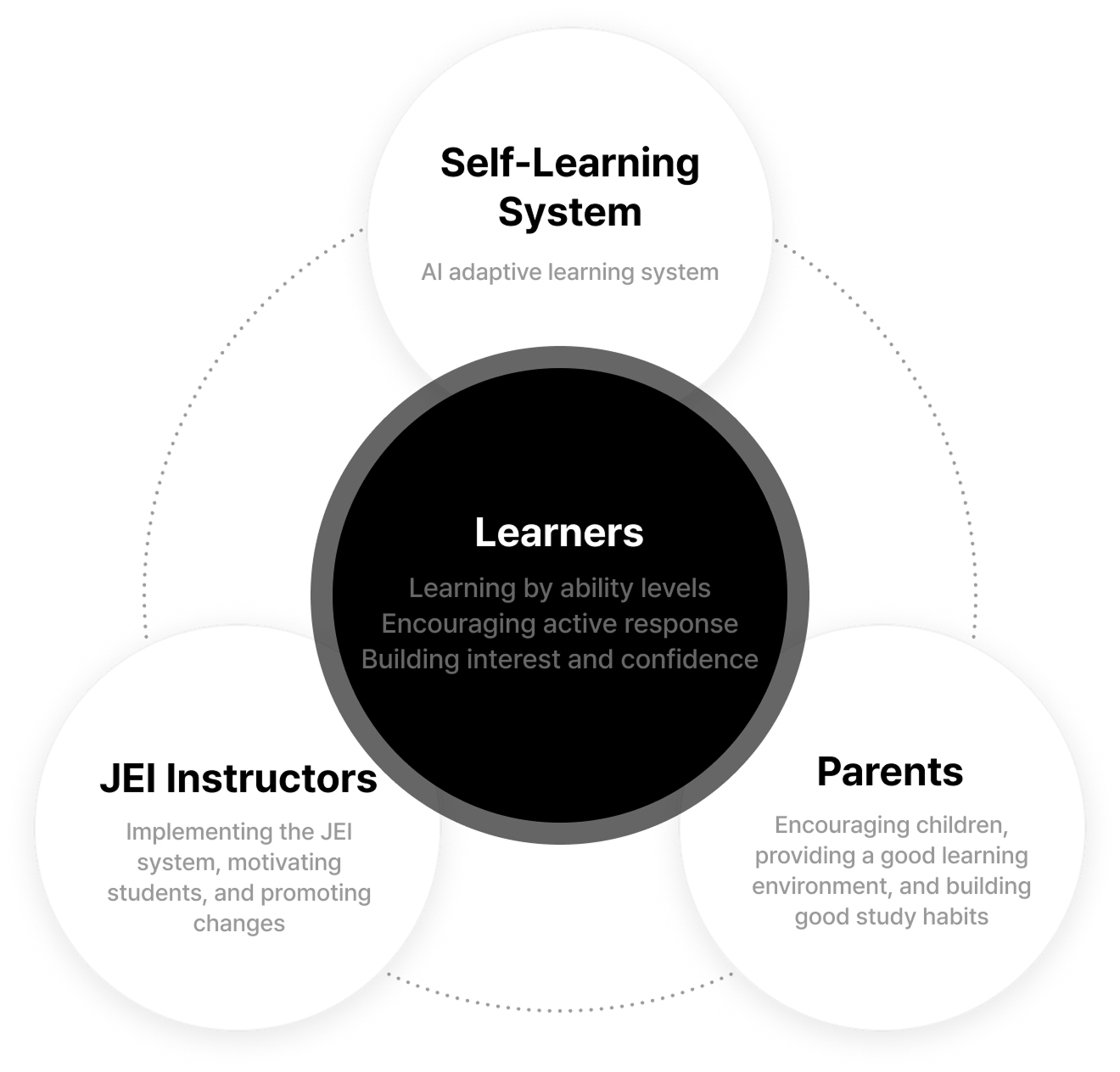
- Curiosity · Interest · Enjoyment
- Sense of Achievement · Confidence
- Motivation · Repetition
- Concentration · Formation of Self-Learning Habits
- Perseverance · Positivity
- Creativity · Problem-Solving Skills
- Fostering creative individuals
with the ability to learn autonomously
Fun and Easy
The Joy of Self-Learning
 Spark Fun and Interest
Just as an enjoyable first experience sparks the desire to try again, the first encounter in learning is crucial. The Self-Learning Method helps each learner enjoy studying by identifying an easy starting point through diagnostic assessments, and it enables them to develop an interest in learning.
 Add Confidence
Through learning tailored to each individual's ability, learners gain confidence at each stage by experiencing success, thinking, 'I can do this. I can do it well.' This instills a spirit of challenge and the motivation to engage in the next stage of learning.
 Enhance Concentration
Learning is more effective when it depends on time spent focusing rather than simply on time spent sitting at a desk. For children just beginning their studies, developing concentration is important. So our program is designed for short daily sessions of 10–20 minutes, helping them sustain focus and gradually build their concentration.
 Form Proper Study Habits
Through parents who check and review the learning content daily, and JEI Instructor who visit at scheduled times to conduct learning management, learners are guided to develop the habit of studying regularly.
 Develop the Ability to Learn Autonomously
Habits and abilities are closely related; when the same content is repeated, ability is built up over that time. Through sufficient repetition, rather than one-off learning, learners achieve 'understanding and mastery', enabling them to solve problems smoothly without hesitation and develop advanced learning abilities. This improvement in learning ability helps learners develop the capability to learn autonomously.
 Foster Creative Individuals
For future generations, learning will not be about finding the correct answer, but about discovering solutions through creative approaches. Children who develop the ability to learn autonomously through the Self-Learning Method grow into creative individuals who can apply logical thinking, adaptability, and problem-solving skills to address even the challenges they encounter in everyday life.
10 Key Advantages of the Self-Learning Method
- Clear and Specific Learning Objectives
- By subdividing large-scale learning objectives for each subject area into medium- and small-scale goals, progress can be easily tracked. This allows both learners and parents to clearly understand whether the learning objectives have been achieved.

- Learning Tailored to Individual Abilities
- Through a scientific learning assessment system, we accurately identify each learner's abilities and current level of progress, and then provide a learning environment suited to their needs. In particular, by finding a point where the learner can start with ease and presenting it as the starting point of learning, we strengthen their confidence and sense of continuous achievement, fostering anticipation and interest in learning.

- Intelligent Adaptive Learning System
- Through the short-cycle process of diagnosis-prescription-learning in our 'Intelligent Adaptive Learning System,' we more accurately assess the learner's level and ability and provide rapid feedback. Through automated scoring and 'Learning Achievement Analysis,' enable efficient learning. This ensures that complete mastery can be achieved at every stage and grade level.

- Small Step
- By arranging extremely subdivided learning objectives from the easiest to the most difficult, learning can be achieved more easily. Immediate checks and reviews minimize learning errors and gaps.

- High Interest and Engagement
- The programmed Self-Learning Materials stimulate learners' interest through concept explanations using illustrations and real-life applications such as puzzles and riddles, enabling learners to enjoy learning and stay focused.

- Immediate Feedback
- The Self-Learning Method emphasizes and encourages active parental involvement, enabling immediate feedback on daily learning. In addition, weekly visits from the JEI Instructor further strengthen the provision of timely feedback.

- Understanding of Concepts and Principles
- Since learning is based on an understanding of concepts and principles, learners feel a stronger sense of interest and achievement. This, in turn, fosters anticipation for the next stage of learning, maximizing learning effectiveness through increased motivation.

- Four-Step Process
- The program-based Self-Learning Materials are scientifically designed to allow the sequence of Introduction-Intensification-Practice-Evaluation for each learning objective. Through this structured approach, learners are provided with sufficient practice to understand and master concepts and principles, thereby enhancing their problem-solving and application skills.

- Short Time, Fast Progress
- The program-based Self-Learning Materials are designed to enable learners to focus for 10-20 minutes a day. By steadily completing the assigned portions, learners can finish the equivalent of a full-grade level curriculum in just six months. Learners can improve their concentration and learning efficiency, enabling them to complete the foundations of learning at an earlier stage.

- Ability to Learn Autonomously
- The ability to learn autonomously is developed through the Self-Learning Method and Mastery Learning. Regardless of age or grade level, when children consistently engage in repeated practice with tasks precisely suited to their abilities, they not only achieve higher academic performance but also cultivate the capacity to learn on their own.